
The twin effects of COVID and Brexit have meant that many employers are finding it difficult to source qualified and experienced finance staff. This has resulted in a job market that really has become a ‘candidates market’ and not only is it becoming harder to find staff but retaining them is also very demanding. So if you are looking for new staff, or you want to hold on to the ones you’ve got, how can you make your roles more attractive?
In this post, we’re looking at the natural advantages that finance has and how you can use these to develop your staff satisfaction.
Finance recruitment in crisis?
One of the most surprising things that has happened as the UK came out of the COVID lockdowns is that staff shortages have rapidly emerged. It seems that across the whole UK economy, employers are having difficulty sourcing people with the right skills and expertise needed to run their businesses with accountancy and finance being no exception.
In the 2021 edition of the Hays Accountancy and Salary Guide, almost three quarters (73%) of accountancy and finance employers said that they had experienced some form of skills shortages within the past year.
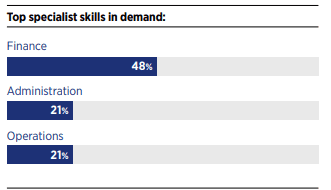
Source: Hays Accountancy and Salary Guide 2021 (1)
But when you combine this with the fact that in the same survey, more than half of finance leaders said that they intend to increase the size of their team in the next 12 months, then you can see that the jobs market is going to get even more competitive.
For multinationals and very large accountancy practices, this is less of a problem. The cachet of working for one of the big names will always be a draw and if you have deep pockets then you can afford to buy the best. But for the rest of us, a tightening jobs market makes life so much more difficult.
So what can employers do to attract and retain the best staff?
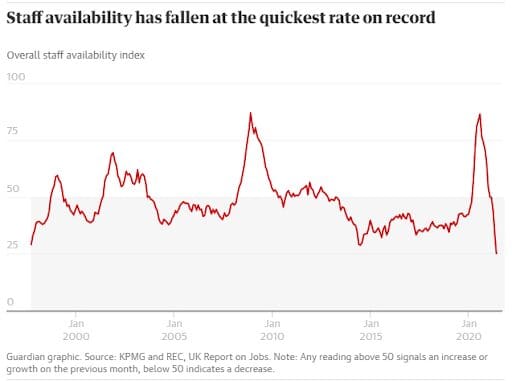
Source: The Guardian (2)
Using your assets 1 – Developing your staff and your systems
Is a tightening jobs market necessarily a bad thing?
Well not necessarily. In fact, times of difficulty are often the breeding ground for leaner and more effective businesses. As Albert Einstein said, “In the middle of difficulty lies opportunity.” and in our opinion, that’s the way to approach the current staff shortages.
The first question to ask is whether this is an opportunity to automate your processes. Do you really need to find a new accounts payable assistant when actually you could simply automate the whole process?
Staff shortages give you an excellent opportunity to take a wholesale look at your systems and processes and delete unneeded steps and automate where you can, leaving you with a leaner team. Of course, this process doesn’t work when you are looking for higher-level skills so what do you do when you need a new finance business partner or senior analyst?
According to Mark Farrar, Chief Executive of the AAT (Association of Accounting Technicians), “Although there are significant concerns for many people around job security, this does present a huge opportunity as well – highlighting the need for retraining and upskilling individuals in order to drive the country’s economic recovery.”
Many companies already have an untapped pool of potential in their current employees and actually when you compare the costs of retraining and upskilling to the fees charged by employment agencies then it makes complete sense.
Your people already know the company and you already know that they have the right attitude, so investing in them is a pretty sure bet and the best thing is that when people see that their managers believe in them they tend to stick around for longer. Admittedly, upskilling your team is often (although not always) a longer process than recruiting from outside but we’d argue that it has a lower chance of failure, because the person has already integrated into your company culture.
Using your assets 2 – Think flexible
The pandemic has presented finance teams with a superb opportunity to truly embrace flexible and remote working. Most companies have found new ways of working that don’t require a 2-hour commute into the centre of a packed city so it makes sense to examine whether that is something that would appeal to their staff.
In a recent US Gallup poll, 44% of people said that they would prefer not to return to the office once restrictions were lifted and a further 23% said that they would like to retain at least some home working.
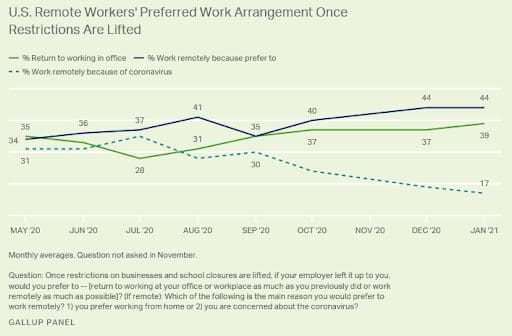
Source: Gallup Poll Feb 2021 (3)
So if people prefer to have at least some home working and your company has already developed the functionality within your systems to allow this then it is a short step to make this a feature of your offer to new and existing staff.
Head of People Policy at the British Chambers of Commerce, Jane Gratton said: “Whether people have found work in a different sector, changed their working patterns, or left the UK during the recession, firms are now struggling to find the people they need. Adopting more remote and flexible working patterns will help firms attract skills from a wider talent pool.” (4)
More than ever, people are looking at ways that they can adapt their work to give them a better lifestyle and allowing people to choose their work location and the days that they spend in the office helps them to do this.
Of course, the traditionalists will cry that their staff will be less productive if they aren’t constantly monitored but many studies have disproved this hoary old cliche.
A perfect example is a study carried out by researchers at Stanford University which showed that “Home working led to a 13% performance increase, of which 9% was from working more minutes per shift (fewer breaks and sick days) and 4% from more calls per minute (attributed to a quieter and more convenient working environment).” (5)
The question has to be; if your finance team are producing world-class work, do you care whether they are in the office or at the beach when they do it?

Finance has a number of inbuilt attributes that make flexible ‘lifestyle’ working a relatively simple matter. Most systems are now either resident in the cloud or have remote connectivity built-in. Many can even be accessed using an app on a mobile device. The finance calendar is known in advance, so a finite amount of work that takes 37 hours to do can just as well be accomplished over four longer days rather than 5 shorter ones. And does it really matter if the bank rec is done at 9 pm on a Sunday or 9 am on a Monday?
Typically, higher-level finance responsibilities tend to be split between analysis type work that can be done anywhere and face to face meetings that work better in person. This means that the Financial Controller could work at home three days a week and come in for the two days where they are hosting a team meeting or working with the Ops Director on budgets.
So will this help to attract and retain staff?
Well, in a recent Deloitte survey an astonishing 94% of people said that they would benefit from work flexibility and where companies have offered this option 82% say they have used them. (6)
Would flexible working attract people on its own? We’d say probably not but the important point is that it may make all the difference when you have candidates who are weighing up competing offers. We’d also argue that as people’s home circumstances change, flexible working can be used as a way to retain valuable staff who may otherwise look elsewhere for a job that fits in with their new lifestyle.
So if you have all of these options at your disposal it would be crazy not to use them.
The world of work is changing – and finance is in the lead
Even before COVID, many finance teams were adopting flexible styles of working that were made possible by technology. So as we enter a new form of industrial revolution, employers that embrace new ways of working and are responsive to the needs of their people are more likely to be successful in their search for talent.
Retaining people is by far the cheapest and most reliable way to run your team and so offering people the option of flexible working both in terms of location and hours is a great way to ensure that they don’t leave when their circumstances change. Employees want it and employers can benefit from it so why wouldn’t you go for flexible working – before your competitors do?
itas are the leaders in flex-tech
We specialise in helping companies to revolutionise their processes and revitalise their systems. If you’d like to find out more about how you can automate your systems and allow your teams to work wherever they need to then why not get in touch and we’ll talk you through it. Alternatively, find out how Cloud Accounting can open you up to a world of benefits, here.

References
- https://www.hays.co.uk/documents/34684/11934063/Hays-Accountancy-Finance-Salary-Guide-2021.pdf/
- https://www.theguardian.com/business/2021/jul/08/uk-employers-struggle-with-worst-labour-shortage-since-1997
- https://news.gallup.com/poll/329501/majority-workers-continue-punch-virtually.aspx
- https://www.britishchambers.org.uk/news/2021/07/quarterly-recruitment-outlook-70-face-difficulty-finding-staff-as-workforce-growth-expectations-surge
- https://nbloom.people.stanford.edu/sites/g/files/sbiybj4746/f/wfh.pdf
- https://www2.deloitte.com/us/en/pages/about-deloitte/articles/press-releases/deloitte-survey-most-professionals-take-advantage-of-flexible-work-options.html
We are a multi-award-winning, platinum Sage Partner, specialising in Sage 200 Professional, Sage 200 Standard, Sage Intacct and Sage 50 accounting solutions.
At itas, we believe in working in partnership with you to deliver the perfect solution that you want and need. We will design a tailor-made business management solution specifically for you and your business, giving you the freedom to focus on what you do best.
