
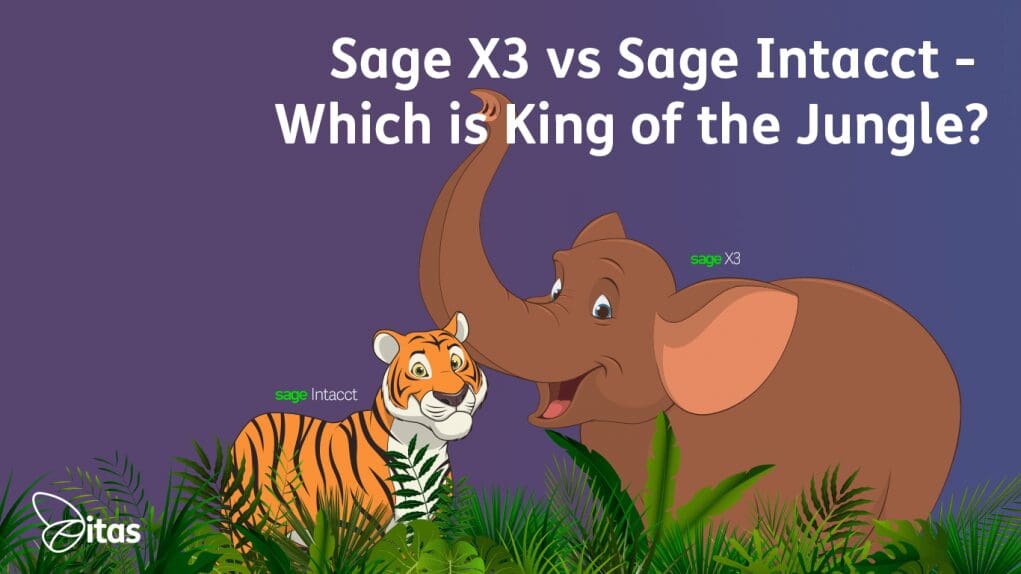
I’m guessing that by reading this blog, you are perhaps looking to evaluate which direction to explore when looking for a new finance system and I think that fundamentally it’s important to mention that both Sage Intacct and Sage X3 are powerful systems but they suit a very different clientele. You might be wondering (with good reason I might add) why on earth we are referencing a jungle when talking about finance software but it will all hopefully become clear in the next few paragraphs.
So, whilst I am no expert in zoology, if you think about the question, ‘who is the king of the jungle?’ you might come up with several answers… in fact, if you ask Google, even they can’t decide! This illustrates my point rather nicely, that making a decision on the best platform depends on the criteria that you are basing your decision on. If you ask me which software is best, the answer is, (in typical consultant fashion) it depends on who it is for!
So without spending the next 1000 words talking about lions, gorillas, tigers and elephants (though sometimes I do wonder whether that would be slightly more interesting than accounting software!), I am going to attempt to help you navigate the exciting but sometimes confusing world of Sage Business Cloud and we are going to do it against 5 different criteria:
- ERP vs Best-of-Breed
- Industry suitability
- Budget
- Implementation timeframes
- Deployment
Criteria 1 – ERP vs Best-of-Breed
Think elephant vs tiger
What do we mean by best-of-breed finance software? In this scenario, we are talking about Sage Intacct. Rather than catering to every function required by the entire business, Intacct has been designed around the principle of using the best tool for the job. Rather than having everything in one system, you choose (and may change) the systems that you want to use, i.e. Salesforce CRM and then connect them in using Sage Intacct’s powerful native cloud API as your core finance system. Now, does this mean that Sage Intacct only does basic finance? Absolutely not. Sage Intacct has all the financial tools that you need to run your business i.e. subscription billing, project accounting, etc. With Intacct, you can connect your financial operations to other areas of the business without having to compromise on functionality. The finance team get a system designed for them and you don’t have to argue with the sales team about what software they should use, they can choose, all pulled together with a powerful Salesforce integration (which by the way is actually supported by the Sage Intacct team under their buy with confidence guarantee!). If flexibility of systems and the ability to flex quickly (i.e. the tiger) is important to your business, then a best-of-breed approach would probably work best for you. However, if you want a single system across your entire business then it may not be the right platform for you.
Enter the elephant (aka Sage X3)
X3 has a very different approach. Designed to be used across the wider organisation it has CRM and extensive operational functionality such as MRP which means you can use the same system across multiple areas of the business. Whilst not as agile as Sage Intacct, it does have a much wider set of functionality that covers more areas. Sage Intacct is more focused on the depth of functionality with the finance operations.
Many of us have come from a background of traditional ERP, it’s the name of the game. One system for your entire business and if that’s what meets your needs then X3 is definitely a better fit for your business. But if you are looking for the best financial tool for the job and one that is powerful, flexible and adaptable – Sage Intacct is definitely the way to go.
So in your eyes who is the King of the jungle so far? Not sure? Read on!

Criteria 2 – Industry Suitability
Another key piece of information that will affect your decision around which product is right for you is definitely the environment that you live in. I could at this point continue my jungle metaphor with a reference to the Amazon Rainforest vs the Lacandon jungle but I think you get my point!
The industry you are in could be a deciding factor for you in this particular case. X3 has a much broader scope in terms of the industries it supports whilst Sage Intacct is much more focused (and we can argue about which is a better approach but let’s leave that to Sage and their development team!).
Sage Intacct is focused on the following industries:
- Financial Services
- Professional Services
- Software & Subscription-Based Businesses (SAAS)
- Tourism and Hospitality
- Not for Profit
- Healthcare
And while X3 does cover those areas from a general finance perspective it also does a lot with Manufacturing as well, so if that is the industry you are in, X3 is a much better choice than sage Intacct. Sage Intacct does have a kitting module but doesn’t handle complex BOM or MRP requirements.
The one that requires some thought and deeper digging are for those in the Distribution industry. If you are looking for advanced distribution planning and have complex traceability focused requirements, then whilst Sage Intacct does have the ability to track batch/serial numbers, X3 is probably a better option. For those that just need a core stock module then Sage Intacct is still a good option for you as it does handle multi-location and basic traceability requirements.
Criteria 3 – Pricing for Sage Intacct and X3
Sage Intacct is modular, so pricing can vary dramatically depending on your requirements. It is designed to scale from small startups to large enterprise and the pricing reflects that. The core financials system with a single user and entity is around 6k but as you add more entities, users and modules the pricing increases. The average annual licence cost is around 25k to put this into perspective.
Implementation costs for Sage Intacct can also vary but a good rule of thumb is around 1 – 1.5x the licence costs. There are exceptions to that, for example, our Sage Intacct Fast Start programme starts from around 8k but of course, depending on the implementation approach and modules chosen, it can vary dramatically.
Pricing for X3 is a very different ballgame. As an example for a small finance implementation, you will need to budget between £120-160k for the first year and then £30-50k annually. For a standard ERP implementation, you would be looking at an initial investment of £150k in the first year and then around £50k+ annually.
For those who are feeling like both of those are out of budget (particularly those in manufacturing or distribution) then why not check out Sage 200 Standard (Cloud-Based) or Sage 200 Professional?
Criteria 4 – Implementation timeframes for Sage Intacct and X3
This is where there is a real divergence. Intacct is designed to be configured, not developed. Its implementation time to go live can range from 4 weeks (on our fast start programme) to 6 months for a particularly long project. A typical implementation time is 3 months.
Sage X3 projects on the other hand are a different matter. Due to the very customisable nature of the product, implementations are complex and so can take anywhere from 6–12 months to fully implement. For more substantial projects, that timeframe can occasionally extend longer depending on the size and complexity of what is needed.
Criteria 5 – Deployment
This is another area where the two products are radically different. Sage Intacct was born in the Cloud and as such, has an infrastructure that is designed to be automatically upgraded and updated. It currently has around 4 new releases per year that are automatically applied to your solution and of course, the cost of these and your infrastructure is included in the price.
X3 has more of a traditional ERP approach but it can be hosted in either Sage provided hosting or on your own private Cloud, which is something to bear in mind when considering the cost. Obviously, you get the benefits of having control over your infrastructure, which is great for those that want that, but just bear in mind that because of the highly customisable nature of X3, upgrades can be costly and complex to manage.
Conclusion
So with that in mind, it is now over to you to decide who is King of your jungle! Is it the agile yet powerful tiger (Sage Intacct) or the strong and all-encompassing elephant (X3)? Over to you to decide! If you would like to learn more about either product then please do reach out to our expert team. Whilst Sage Intacct is definitely our strength here at itas (we won Sage Intacct UK partner of the year in case you didn’t know!) we can also recommend a great X3 partner that we refer our customers to and that we know will look after you.
So that’s all for this blog, we would love to hear your thoughts or any other questions you may have about either product and we can answer in our next piece of content!


